11 Card Games for Couples: Date-Night Picks for Two
Eleven card games for two adults spending an evening together, sorted into quick games, long games with a running score and two-player solitaires, with what each needs and why it works for a couple.
The best card games for couples are Gin Rummy, Cribbage and Spit. Gin Rummy is the one to make a habit of: a game to 100 points spreads over several hands, so you can stop halfway, leave the score on a scrap of paper and finish it the next night. Cribbage is the deeper game, with enough to learn that it stays interesting for years. Spit is the opposite, a two-minute scramble that usually ends in an argument about whose card landed first. All three need one ordinary deck. Eight more follow, picked for two adults with an evening and a deck.

Our 20 best card games for 2 players covers the full range with complete rules. This list asks a narrower question: which games make a good night in for two people who want to keep talking.
How we chose these games
We kept the two-player games that pass most of five tests.
- Time per hand. A hand should end in minutes, with a running score to give the evening a shape.
- Room to talk. Games with natural pauses beat games that need silence. The speed games are the exception, and we say so.
- One deck. Everything except the two-player solitaires needs a single 52-card deck. Cribbage is easier with a board, but pen and paper does the job.
- Learnable in five minutes. One of you should be able to teach the other with the cards already dealt.
- Replay value. A game you have figured out after three evenings is not worth learning together.
The rules below follow Pagat (pagat.com), the long-running card-game rules site, with Wikipedia where Pagat has no page.
All 11 games at a glance
Time per hand is our own estimate for two players who know the rules.
| Game | Time per hand | Mood | What you need |
|---|---|---|---|
| Spit | 2 to 5 minutes | Fast and silly | One deck |
| Egyptian Ratscrew | One open-ended game | Fast and silly | One deck |
| Crazy Eights | About 5 minutes | Light and chatty | One deck |
| Kings in the Corner | About 10 minutes | Low-conflict | One deck |
| FreeCell as a team | 10 to 15 minutes a deal | Cooperative | One deck |
| Gin Rummy | 5 to 15 minutes | Slow and strategic | One deck, pen and paper |
| Cribbage | 10 to 15 minutes | Slow and strategic | One deck, a board or paper |
| Casino | 10 to 15 minutes a round | Slow and strategic | One deck, paper |
| Golf | 3 to 5 minutes a hole | Light, running score | One deck, paper |
| Spite and Malice | 20 to 40 minutes | Two-player solitaire | Two decks |
| Russian Bank | 30 minutes or more | Two-player solitaire | Two decks with different backs |
Quick games for a short evening
Reach for these when you have twenty minutes or want a break from a longer game. Two are noisy, two are gentle, and one has no loser.
1. Spit, the two-minute scramble
Deal the whole deck, 26 cards each. Each of you lays out five stock piles of one, two, three, four and five cards, top card face up, and holds the other 11 face down as spit cards. You both say "spit" and turn a spit card into the middle, which starts two center piles.
Then you play at the same time. Any face-up stock card can go on either center pile if it is one rank higher or lower, suit ignored, and the sequence wraps from King to Ace. When neither of you can move, you both spit again. When one of you clears their stock piles, you both slap a center pile, usually the smaller one, and each player takes the pile they slapped and deals the next round from that plus whatever they still hold. You win by running out of cards completely. Pagat gives a five-card-hand version under the name Speed.
Why it suits a couple: it is short, loud and hard to take seriously, a good opener or a reset after a long game. The limitation: nobody talks while it runs, and if one of you is much quicker, the other loses most rounds.
2. Egyptian Ratscrew, for a loud evening
Deal the deck out evenly, face down, and do not look at your cards. Take turns playing one card face up onto a single center pile.
When someone plays a face card or an Ace, the other player has a set number of tries to answer with a face card or Ace of their own: four for an Ace, three for a King, two for a Queen, one for a Jack. If they fail, the challenger takes the pile. Either of you can also slap the pile when the top two cards match, called a double, or when two matching cards have one card between them, a sandwich. First hand down wins the pile; a wrong slap costs you cards. Whoever collects every card wins.
Why it suits a couple: there is no strategy to learn, so it works late in the evening. The limitation: a game can drag as the pile changes hands, so agree a time limit, and agree which slaps count, since tables set their own.
3. Crazy Eights, the easiest one to teach
Deal seven cards each, turn the next card face up to start the discard pile, and leave the rest as the stock.
On your turn, play a card that matches the top discard by rank or suit, or draw from the stock. An Eight goes on anything, and whoever plays it names the suit the other player must follow. In Pagat's two-player rules a Queen makes your opponent skip a turn, so you play again. The first to empty their hand wins, and the other player counts penalty points for what is left: 50 for each Eight, 10 for a picture card and face value for the rest.
Why it suits a couple: there is one decision per turn, so the conversation does most of the work. The limitation: it is mostly luck, and two keen players will want more to think about after a few hands.
4. Kings in the Corner, the low-conflict pick
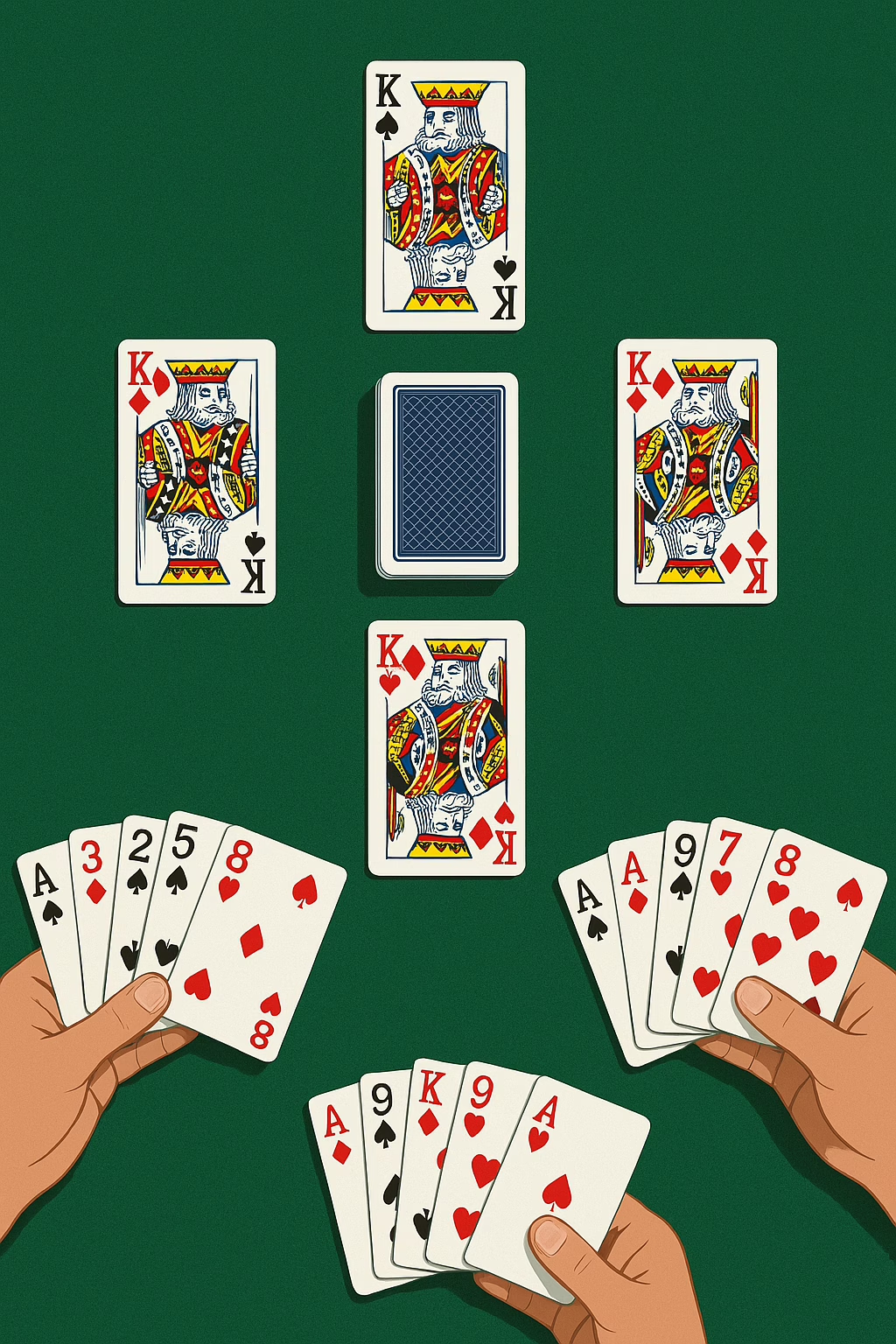
Deal seven cards each and put the stock in the middle. Turn four cards face up around it, one on each side, and leave the four diagonal corners empty for Kings.
On your turn, play as many cards as you can or want. Piles build down in alternating colors, as in Klondike. A King from your hand starts a corner pile, a card from your hand fills an empty side space, and you can move a whole pile onto another when its bottom card fits. Then draw one card, which ends your turn. The first to play every card from hand wins the deal. Pagat scores what the other player is still holding, 10 for a King and 1 for anything else, toward a target agreed in advance, such as 25 or 50, and the lowest total wins.
Why it suits a couple: you build on the same piles instead of attacking each other, so it is the gentlest competitive game here. The limitation: the draw decides a lot of hands, and once you can both see every move there is little to separate you.
5. FreeCell as a team, the cooperative option
FreeCell is a one-player game, so this is a way of playing it. Deal all 52 cards face up into eight columns, four of seven cards and four of six. Above them sit four free cells, each holding one card, and four foundations that build up by suit from Ace to King.
Columns build down in alternating colors, and a free cell holds a card while you dig. Nothing is hidden, and almost every deal can be won: Wikipedia records only one unsolvable deal among the 32,000 in the original Microsoft version. Play it as a team. One of you suggests a move, the other agrees or argues for a better one, and you win or lose together. Our FreeCell strategy guide covers the habits that win deals.
Why it suits a couple: neither of you can lose to the other. Almost every traditional card game for two is a contest, so this is the closest a standard deck gets to cooperative play. The limitation: it is quiet, think-out-loud play, and the person who spots moves faster can end up playing alone. If you would rather not lay out 52 cards, play FreeCell free in the browser and pass the screen.
Settle-in games with a running score
These are for when the evening is the plan. Hands are short, but the score carries over, so someone pulls ahead, someone catches up, and the last hand matters. Keep a pen and paper by the deck.

6. Gin Rummy, the one to make a habit of
Deal ten cards each. Turn the next card face up to start the discard pile and leave the rest as the stock.
Each turn you draw one card, from the stock or the discard pile, and discard one. You are building melds: three or four of a kind, or runs of three or more in one suit. Unmatched cards are deadwood, counted at face value, with pictures at 10 and Aces at 1. Once your deadwood is 10 or less, you may knock and lay your hand down. Going gin, with no deadwood at all, earns a 20-point bonus. Knock with too much and your opponent may undercut you, scoring the difference plus 10. The first to 100 points wins the game and a 100-point bonus on top.
Why it suits a couple: every turn has a small decision, but none is urgent, so you can talk throughout. A game to 100 fills an evening without taking it over. The limitation: the first few games are lopsided if one of you has played for years, because knowing when to knock is most of the skill.
7. Cribbage, the game you learn together
Deal six cards each. You each put two face down into the crib, a spare hand that scores for the dealer. The non-dealer cuts, and the dealer turns up a starter card. If it is a Jack, the dealer pegs 2 straight away.
You then take turns laying cards face up in front of you and calling the running total, which may not pass 31. Making exactly 15 or 31 scores 2, a pair scores 2, three of a kind 6, and runs score a point per card. Afterward, each hand and then the crib is counted together with the starter: fifteens, pairs, runs, flushes and the Jack of the starter's suit, called his nob. Points are pegged on a board, and the first to 121 wins.
Why it suits a couple: counting each hand aloud becomes a shared ritual, and the board shows the race at a glance. The limitation: the scoring takes a few evenings to absorb, and the first night is mostly one of you teaching the other.
8. Casino, the capturing game
Deal four cards each and four face up on the table. When both hands are empty, deal four more each, with nothing new to the table. Six deals use up the deck, and that is one round.
On your turn you play one card. You can capture a table card of the same rank, or number cards that add up to it, so a 9 takes a 6 and a 3 together. You can build, combining a card from your hand with table cards into a total you hold a card to capture next turn. Or you can trail, simply laying a card on the table. At the end of the round you score 3 for most cards, 1 for most spades, 1 for each Ace, 2 for the 10 of Diamonds (Big Casino) and 1 for the 2 of Spades (Little Casino). The first to 21 points wins.
Why it suits a couple: the arithmetic makes it unlike rummy, and a build your partner steals from under you gets mentioned for days. The limitation: the build rules take patience, so keep Pagat's page open for the first game.
9. Golf, nine holes on the coffee table
Deal six cards each, face down, in two rows of three. Each of you turns any two face up. The rest is the stock, with one card turned up to start the discard pile.
On your turn, draw from the stock or the discard pile and swap the card into your layout, discarding the card it replaces. A card drawn from the stock can simply be discarded instead. You want a low score: Kings are 0, 2s are minus 2, Jacks and Queens 10, Aces 1 and everything else face value, and a matching pair in one column counts 0. The hand ends when one player has all six cards face up. A game is nine hands, the nine holes, and the lowest total wins.

Why it suits a couple: each hole takes a few minutes, and the face-down cards give every hand a reveal at the end. The limitation: there is not much strategy to discuss, and with two players it comes down mostly to luck and memory.
Two-player solitaire for a long evening
These two break the one-deck rule, and they are worth the second pack. Each is a solitaire you play against one another. Both also appear in our guide to card games with two decks, and Russian Bank is covered step by step in two-player solitaire games.
10. Spite and Malice, the quiet race
Shuffle two decks together. Deal each player a pay-off pile of 20 cards with the top one face up, and a hand of five. The rest is a shared stock.
Up to three center stacks build from Ace up to Queen, suits ignored, and Kings are wild. On your turn you draw back up to five, play what you can to the center from your hand, the top of your pay-off pile or your side stacks, and end by discarding one card onto one of up to four side stacks of your own. The first to play the last card of their pay-off pile wins.
Why it suits a couple: turns are calm, and the real game lies in which card you hold back so the other person cannot use it. It is competitive in a quiet, needling way that suits the name. The limitation: you need two decks, and if the stock runs out before anyone wins, Pagat calls the game a draw.
11. Russian Bank, the deep one
Each player uses their own deck, ideally with different backs. Deal yourself a reserve of 13 cards with the top one face up, then four face-up cards in a column toward the middle, and keep the other 35 face down as your hand. The eight face-up cards are shared tableau piles, and eight foundations go between them.
Foundations build up by suit from Ace, and tableau piles build down in alternating colors. Your turn lasts until you turn up a card from your hand that you cannot play and place it on your waste pile. You can load your opponent by putting a card of the same suit, one rank up or down, onto their reserve or waste pile. Some moves are compulsory, such as playing your reserve card to a foundation when it fits, and if you miss one, your opponent calls "Stop" and the turn passes. The first to get rid of reserve, hand and waste pile wins.
Why it suits a couple: it is the most absorbing game here, and one of you plays while the other watches for a mistake to call. The limitation: it takes an evening to learn, and the "Stop" rule can make it the most argumentative game here.
Picks by situation
- If you have ten minutes before dinner: Spit, or a few holes of Golf.
- If one of you is new to cards: Crazy Eights, then Kings in the Corner.
- If you want a game to play most evenings: Gin Rummy to 100.
- If you want something to learn together over months: Cribbage.
- If neither of you wants to compete tonight: FreeCell as a team.
- If the evening is loud and you want to laugh: Egyptian Ratscrew.
- If you have two decks and a whole evening: Spite and Malice, then Russian Bank once you know it.
- If one of you wants to play alone for a while: a solitaire game. Our own mobile game, Solitaire Castle Royal, is single-player TriPeaks, so it is no help for playing together, but it suits the half hour when one of you wants a game to yourself.
If you only learn one game from this list, make it Gin Rummy, then choose the second by mood: Spit when the evening is loud, Cribbage when you want something to get better at together, and FreeCell when neither of you wants to beat the other tonight. When these start to feel familiar, our full list of 20 two-player card games has the next ones to try.