The History of Solitaire: From Royal Courts to Mobile Apps
Solitaire has been captivating players for over 250 years. Discover how a quiet European card game evolved from aristocratic parlors into a global digital phenomenon played by millions every day.
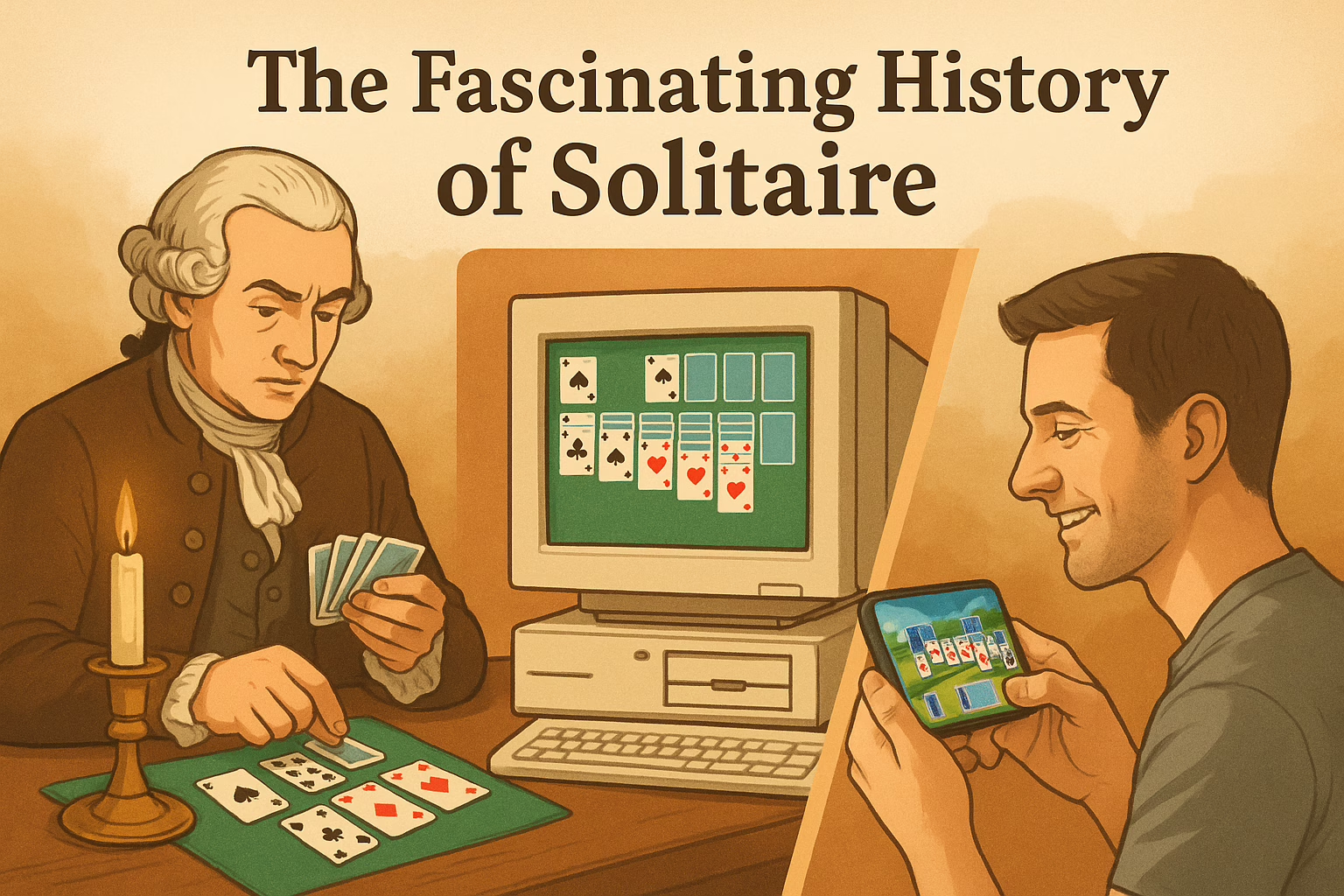
From the candlelit parlors of 18th-century Europe to the smartphones in our pockets, the history of Solitaire is as captivating as the game itself. What began as a quiet, solitary pursuit among the educated classes has evolved into one of the most played games in human history — spanning physical cards, early computers, and now mobile apps with millions of daily users. This is the full story of how Solitaire conquered the world.
The Origins of Solitaire: 18th-Century Europe
The precise origins of Solitaire remain a matter of friendly debate among historians. The earliest documented references to Solitaire-style card games appear in 18th-century France and Germany. The French term "réussite" (meaning "success" or "it worked") was used for these single-player games, and the English borrowed the concept under the name "Patience" — a word that elegantly describes both the game's pace and the temperament it cultivates.
By the late 1700s, Solitaire had appeared in printed card game collections, most notably in German publications. Some historians speculate that the game may have developed from German or Scandinavian cartomancy practices — fortune-telling with cards — which were repurposed into structured games. Others point to Patience-like arrangements described in French publications of the period. Whatever the precise path, Solitaire was already circulating in educated European society by the turn of the 19th century.
One persistent legend suggests that Solitaire was played by Napoleon Bonaparte during his exile on Saint Helena. While this is difficult to verify, the story captures something true about the game: its deep meditative appeal to individuals with time to think.
Solitaire in Victorian England and Printed Media
The 19th century was transformative for Solitaire. As playing card manufacturing became cheaper and more widespread, card games spread rapidly through all layers of society. Solitaire, in particular, was embraced by Victorian England as a respectable parlor pastime — introspective, solo, and refined. It aligned perfectly with Victorian ideals of self-improvement and quiet domestic leisure.
Crucially, this era saw Solitaire transition from oral tradition to printed documentation. Game compendiums and rulebooks began standardizing the rules of various Patience games. Lady Adelaide Cadogan's Illustrated Games of Patience (published in the 1870s) was among the first major English-language books dedicated to Solitaire-style games. Henry Jones's Patience Games and later volumes by Mary Whitmore Jones expanded the canon further, cataloguing dozens of named variants.
This printing and standardization of rules was critical. It transformed Solitaire from an informally shared pastime into a structured, reproducible form of entertainment with consistent rules that could be taught, debated, and refined. By the end of the Victorian era, Solitaire had become a fixed part of British and Continental social culture.
Solitaire Crosses the Atlantic
As European immigrants settled North America throughout the 18th and 19th centuries, they carried their card games with them. Solitaire adapted naturally to the American context, where long winters and isolated homesteads created demand for solo entertainment. The game spread through American households much as it had spread through European ones — person to person, aided increasingly by mass-printed card game books.
The most significant American contribution to Solitaire's story is the rise of Klondike Solitaire. This variant — now simply called "Solitaire" by most of the world — is believed to have gained its name and widespread popularity during the Klondike Gold Rush of the late 1890s in Canada's Yukon territory. Prospectors enduring harsh conditions and long waits found in Klondike Solitaire the perfect companion: a game requiring nothing but a deck of cards and a flat surface.
Magazines and newspapers throughout the late 19th and early 20th centuries began publishing Solitaire columns, further embedding the game in American popular culture. The game's accessibility — no opponents needed, no complex equipment — made it uniquely suited to American individualism.
The Digital Revolution: Microsoft Solitaire (1990)
The single most consequential moment in Solitaire's history came in 1990, when Microsoft included Solitaire in Windows 3.0. The game was created by intern Wes Cherry, with card artwork by designer Susan Kare (who had previously designed the iconic original Macintosh icons). Microsoft's stated purpose was practical: help new computer users get comfortable with the mouse — drag-and-drop, clicking, and pointing — through an intuitive, non-threatening activity.
The effect was transformative and far beyond anything Microsoft anticipated. Solitaire became one of the most widely used programs on Windows PCs worldwide. For hundreds of millions of people, it was their introduction to computer interaction. Office workers played it between tasks. Students played it during free periods. Parents played it after putting children to bed. The game that had taken 200 years to spread across Europe reached the entire world in a decade through software distribution.
The Expansion of Solitaire Variants in the Digital Age
The success of Klondike on Windows opened floodgates of innovation. FreeCell was added to Windows in 1991, offering a fully transparent (all cards face-up) strategic challenge that proved almost universally solvable and built a fiercely devoted following. Spider Solitaire joined the Windows suite in 1998, introducing a two-deck, suit-sequence format that appealed to players craving a more complex challenge.
Each variant that gained traction in the Windows ecosystem validated the commercial viability of Solitaire as a digital product, not just a digital port of a card game. Developers began experimenting with new formats: Pyramid, Golf, TriPeaks, Yukon, and dozens more emerged in both freeware and commercial software. Solitaire had become a genre, not just a game. Learn about 10 of the most popular Solitaire variants that have emerged from this period.
The Mobile Revolution: Solitaire in Your Pocket
As mobile technology evolved in the early 2000s, Solitaire was among the very first games to migrate to handheld devices. Early versions appeared on Palm Pilots, BlackBerry devices, and Java-based mobile phones — the touchscreen-free era when directional pads and keypads were the interaction model.
The launch of the Apple App Store in 2008 and the explosion of the Android ecosystem created conditions for a true Solitaire renaissance. Touch screens made card-dragging and tapping feel completely natural. Developers could build immersive, visually rich Solitaire experiences with animation, music, and personalization options that were impossible on desktop. The barrier to entry dropped to zero — free-to-play games funded by advertising or optional in-app purchases meant anyone could download and play immediately.
Solitaire in the Modern Mobile Era
Today, Solitaire is a thriving mobile genre. Modern apps are not merely digital replicas of card games — they are gamified experiences featuring daily challenges, seasonal events, in-game reward systems, leaderboards, and beautifully themed visual environments. The player psychology has been carefully studied and incorporated: streak mechanics, treasure chests, level progression, and daily login rewards all make modern Solitaire apps compelling habits, not just casual time-fillers.
Microsoft Solitaire Collection — the continuation of the original Windows game — has been downloaded over 100 million times globally and generates consistent engagement across desktop and mobile platforms. Alongside it, a rich ecosystem of independent developers has produced innovative takes on the genre, including titles that blend Solitaire with match-three mechanics, RPG narratives, and merge puzzles.
TriPeaks Solitaire, in particular, has emerged as the format most naturally suited to mobile — fast, chain-based, visually satisfying, and perfectly calibrated for short sessions. Games like Solitaire Castle Royal have taken this format and elevated it with premium design, kingdom-building narratives, and deep level design across hundreds of stages.
Solitaire's Cognitive and Wellness Legacy
Throughout its long history, Solitaire has been valued not just as entertainment but as a mental exercise. The game trains focus, short-term memory, pattern recognition, and strategic planning. It provides a meditative, low-stimulus environment that many players describe as genuinely calming — a structured problem to inhabit that gently quiets a busy mind.
These qualities have made Solitaire a tool of interest to educators, wellness advocates, and cognitive researchers. It has appeared in brain training apps, occupational therapy settings, and recommendations for maintaining mental agility across age groups. Explore the full picture in our article on the health benefits of playing Solitaire.
The Global Appeal That Has Endured for 250 Years
What is the secret to Solitaire's extraordinary longevity? Several qualities work together:
- Universal accessibility: No language barrier, no opponent needed, minimal equipment.
- Scalable challenge: From simple variants suitable for children to fiendishly complex versions for experts.
- Emotional satisfaction: The completion of a game — especially after a difficult session — delivers genuine reward.
- Adaptability: Every new technology platform has welcomed Solitaire naturally, from printed rulebooks to PCs to smartphones.
- Timelessness of the core mechanic: Organizing chaos into order through careful moves is a deeply human satisfaction that never gets old.
From Napoleon's supposed exile games to the offices of the 1990s PC era to the smartphones of today, Solitaire has traveled further and touched more lives than almost any other game in history. And with mobile gaming continuing to grow globally, its story is far from over.
Experience the latest chapter of that story with Solitaire Castle Royal — a beautifully crafted TriPeaks Solitaire game that honors everything players have always loved about Solitaire while delivering the best of modern mobile game design. Discover why TriPeaks Solitaire is winning over classic fans worldwide.